
Healing from trauma doesn’t always mean reliving the past. Sometimes resilience grows quietly from within.
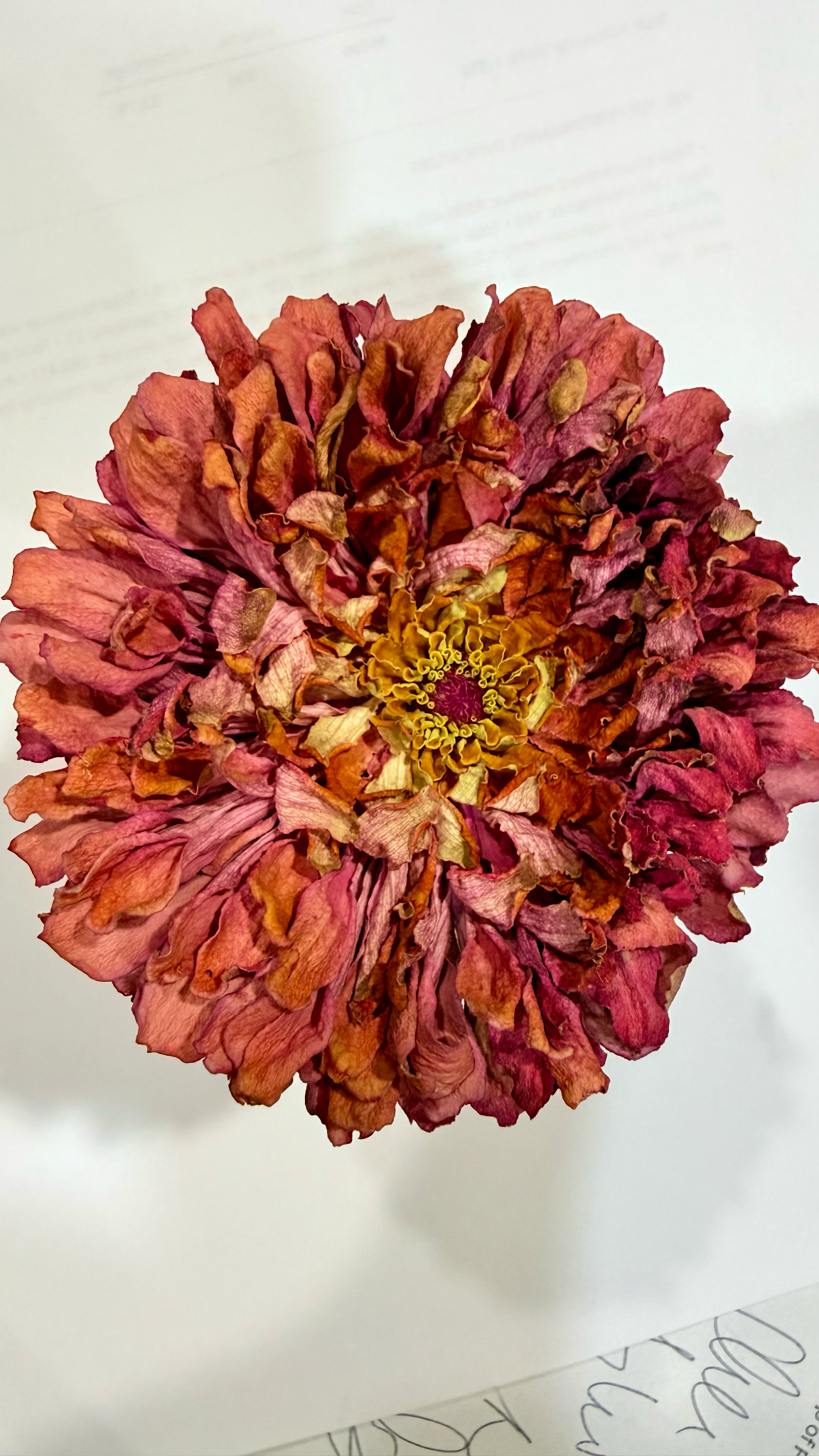
At first glance, this flower appears to be fading.
Its petals are curled, softened, and weathered by time. The brilliant pinks of its youth have deepened into shades of burgundy, copper, and gold. What was once perfectly symmetrical has become textured, layered, and uniquely beautiful.
But look closer.
The most vibrant part of the flower is its center.
While the outer petals tell the story of every season it has endured, the heart of the flower remains alive, intricate, and full of quiet strength. It has not survived despite the passing of time—it has been transformed by it.
I often think that people are much the same.
Life leaves its marks. Trauma, grief, disappointment, illness, and loss shape us in ways we never anticipated. We do not emerge untouched. The outer layers of our lives often carry visible evidence of what we have endured.
Yet our deepest strength is rarely found on the surface.
If healing is allowed to unfold, suffering can become the birthplace of compassion. Adversity can cultivate humility. Loss can deepen gratitude. Over time, resilience is no longer something we strive to achieve—it becomes woven into who we are.
Perhaps this is the true beauty of aging.
Aging is not simply growing older. It is the gradual accumulation of wisdom, perspective, self-respect, and appreciation for the life we have lived. Every challenge, every disappointment, every relationship, and every recovery contributes to the person we become. The years themselves are not the achievement. The growth they invite is.
Like the center of this flower, our inner life can continue to flourish even when the outer layers appear weathered.
For decades, trauma healing has often focused on revisiting painful memories. For many people, trauma-focused therapies and exposure-based approaches are profoundly helpful and remain an important part of mental health treatment. Yet neuroscience has also shown us another important truth.
The brain is capable of change throughout life.
This remarkable ability, known as neuroplasticity, allows us to create new emotional pathways, strengthen emotional regulation, and develop healthier patterns of responding to stress. Healing from trauma is not only about remembering what happened. It is also about changing how the brain and body carry those experiences in the present.
Sometimes healing comes not from returning to the wound again and again, but from strengthening the resilient center that has always remained within us.
This understanding has inspired innovative approaches to trauma recovery, including PRISM, which emphasizes emotional regulation, adaptive neural pathways, and the brain’s capacity to learn new patterns of resilience. Rather than asking people to become trapped inside painful memories, these approaches seek to cultivate safety, flexibility, and inner strength so that wisdom gradually becomes stronger than suffering.
The goal is not to erase the past.
It is to reshape our relationship with it.
As our emotional experience changes, so does our capacity for hope, connection, and peace.
That may be the greatest gift of aging.
Not that we remain unchanged, but that we learn to honor every season of our lives. We begin to appreciate not only what happened to us, but also who we became because we kept growing.
Like this flower, our outer layers may reveal the passage of time.
But our center—the place where resilience, wisdom, and healing reside—can continue to bloom long after the petals begin to fade.
Dr. Diana Ghelber is a psychiatrist specializing in trauma, OCD, depression, and innovative neuroplasticity-based treatments, including PRISM and Transcranial Magnetic Stimulation (TMS). Her work focuses on helping people build resilience and rediscover emotional well-being through evidence-informed approaches to healing.